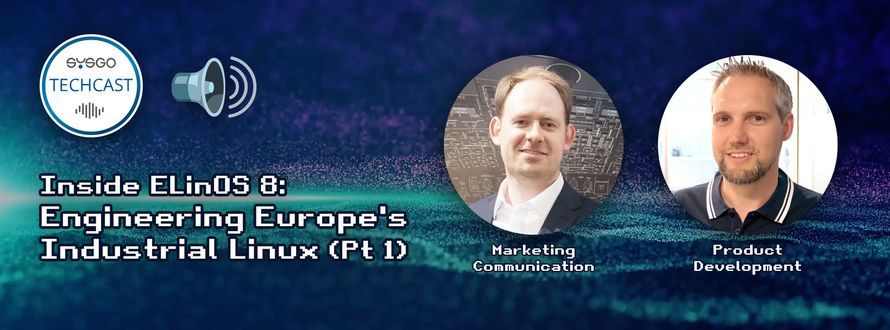
Inside ELinOS 8: Engineering Europe's Industrial Linux for Secure Embedded Systems (Part 1)
– Webcasts & Media, ELinOS, Industrial / IoT, Linux, SecurityWhy Embedded Linux needs a different Approach
Embedded Linux is everywhere. It powers industrial equipment, vehicles, medical devices, communication systems and increasingly complex edge platforms. But Linux running on an embedded device is fundamentally different from Linux running on a desktop or laptop.
For a personal computer, a distribution such as Ubuntu, Debian or Fedora typically provides a broad selection of applications, libraries and services. The goal is flexibility: give the user as much functionality as possible.
Industrial embedded systems often require the opposite approach.
When Linux becomes part of a product that has to operate reliably for many years, protect sensitive data and meet increasingly demanding cybersecurity requirements, every additional component matters. An unused service can become unnecessary attack surface. An unnecessary library adds another dependency to maintain. And software that is not required for the application can increase the complexity of the overall system.
This is one of the fundamental ideas behind ELinOS 8: Start with a minimal system and add only what the target application actually needs.
As the technical product development team behind ELinOS explains, the goal is to help customers create an embedded Linux distribution adapted specifically to their hardware and application requirements.
From generic Linux to Industrial Linux
Industrial systems frequently run on customized hardware. An OEM may use an existing system-on-chip but build its own board around it, add industrial-specific extensions or require specialized drivers.
This is where a conventional mainline Linux distribution may no longer be enough.
The Linux kernel may require modifications. Drivers may need adaptation. The system needs to be configured specifically for the target hardware, while unnecessary functionality should be kept out.
ELinOS addresses this through a development environment designed specifically for embedded systems. Rather than starting with a large collection of functionality and removing what is not required, developers can start from a minimal system and add the features they actually need.
This approach has an important security benefit: A smaller system can mean a smaller attack surface.
If an application does not need an HTTP server, for example, there is no reason to include one simply because it happens to be available in a general-purpose distribution. Services and libraries can be added when they are required by the application.
ELinOS 8: Expanding Hardware and Security
With ELinOS 8, two areas received particular attention: hardware support and security.
The release adds a range of new Board Support Packages, allowing ELinOS to run out of the box on a broader selection of development kits and boards.
At the same time, security has become an increasingly central part of the platform.
The reason is straightforward: embedded products can no longer be treated as systems that are simply built, deployed and then left unchanged for years.
Vulnerabilities are continuously discovered. Exploits evolve. Dependencies change. And manufacturers need to know whether their products are affected.
For ELinOS 8, this means security is addressed not only through individual technical features, but also through processes and tooling around the operating system.
Knowing what is inside your Embedded System
One of the most important additions in ELinOS 8 is integrated Software Bill of Materials (SBOM) generation.
An SBOM provides visibility into the software components that make up a product. For an embedded project, this can be particularly important because dependencies are not always immediately obvious to the developer.
A project may use a particular application, which depends on a library, which itself depends on additional components. When a vulnerability is discovered, the crucial question becomes:
Are we affected?
The SBOM provides a detailed view of the packages actually included in the project, including information relevant to software licensing. Importantly, the report can be generated for the specific project rather than simply describing every component available in the complete ELinOS product.
This gives developers and product owners a much clearer picture of what is actually running on their target hardware.
Security is a continuous Process
One of the biggest changes in embedded software development is that cybersecurity does not end when the product is released.
In the past, a customer might build a product, deploy it and expect it to operate for many years with relatively little software intervention. Today, that model is increasingly difficult to sustain.
New vulnerabilities can appear at any time. Components need to be monitored and updated. Security advisories need to be evaluated, and customers need to understand whether a particular vulnerability affects their system.
SYSGO therefore continuously monitors publicly available vulnerability information and checks the packages included in ELinOS. When relevant issues arise, customers can receive information and advisories about required updates.
The objective is to take some of this continuous monitoring burden away from the product developer, allowing engineering teams to focus on their application while maintaining a professionally supported operating-system baseline.
ANSSI Hardening: Turning Security Requirements into Engineering Practice
Another security capability discussed in the TechCast is the integration of the ANSSI hardening guidelines and test suite.
ANSSI, the French National Cybersecurity Agency, provides guidelines for securing Linux systems. These cover areas such as user management, unnecessary services, root access and system configuration.
ELinOS provides mechanisms to configure a system toward a defined security level and a test suite that evaluates the running system against the applicable rules.
The result is a report showing which requirements are fulfilled and where additional hardening may be necessary.
This gives developers something particularly valuable in security engineering: a concrete baseline against which the configuration of a system can be assessed.
Rather than simply saying that a system is "secure", engineers can identify specific configuration requirements, test the running system and determine where further hardening is needed.
Security Starts with what you don't Include
Security features are important, but security can also begin much earlier—with the decision about what not to put into a system.
ELinOS projects start with a minimal configuration. Additional services are explicitly added as required, while the project analyzes applications and integrates only the libraries needed to run them.
This creates a deliberately reduced system.
That approach can help reduce attack surface and simplify the system that ultimately needs to be maintained and secured.
ELinOS 8 extends this philosophy with support for immutable operating systems. The root file system can be configured as read-only, while applications can run separately in containers.
Docker and Podman support are available as part of the environment, allowing applications to be added through container images while keeping the underlying operating system protected from modification.
European Industrial Linux: Why Sovereignty matters
ELinOS is positioned as the European Industrial Linux. But what does that mean in practical engineering terms?
For customers developing products for critical markets, control over the software supply chain can be an increasingly important consideration.
ELinOS is ITAR-free, and SYSGO's European location allows it to provide customer support and operate its own infrastructure for open-source software and security monitoring rather than depending entirely on services operated outside the European Union.
This becomes particularly relevant as European institutions develop their own approaches to vulnerability information and software security.
For OEMs and manufacturers, digital sovereignty is therefore not simply a political concept. It can become a practical consideration when selecting the technology and suppliers that underpin long-lived critical products.
Making Embedded Linux Development more practical
Industrial Linux does not only have to be secure. It also has to be usable by engineers.
Building a customized embedded Linux distribution can be a complex task. Frameworks such as Yocto provide enormous flexibility, but that flexibility also means that developers and organizations have to take responsibility for many aspects of the build and maintenance process themselves.
ELinOS takes a different approach.
The platform combines graphical configuration with command-line tools. Its feature configurator connects kernel configuration with file-system integration, allowing developers to enable functionality without manually editing numerous configuration files.
The system can also provide pre-built packages and libraries, while the Linux kernel remains available in source form and can be configured specifically for the target board.
According to the ELinOS development team, this approach can significantly simplify project setup. A project can potentially be created and a target image generated within minutes, rather than requiring developers to first establish and maintain a complete build environment and its dependencies.
One Development Environment, Multiple Tools
The development environment is designed to reduce dependencies on the developer's host system.
ELinOS supports Linux and Windows host environments and provides the tools needed for embedded development within the product itself, including cross-development environments, C and Rust compilers, debugging capabilities and performance tooling.
The goal is straightforward: developers should be able to concentrate on developing their application rather than spending excessive time preparing and maintaining the development environment.
Secure Boot is a Chain, not a Feature
Security also extends beyond the operating system itself.
Secure Boot is a good example. A Linux distribution can be configured securely, but that alone does not guarantee a secure boot chain.
The complete chain needs to be considered—from the hardware and bootloader through certificates and configuration to the handover into Linux and the file system.
ELinOS development services therefore also address this wider chain. The engineering team can examine the target, bootloader configuration and certificates and help identify configuration problems that could break the chain of trust.
The important principle is that Secure Boot is a system-level property, not simply a checkbox inside Linux.
Keeping Systems updatable without losing Control
Long-lived embedded products also need a secure way to evolve.
ELinOS provides over-the-air update capabilities and templates that can be integrated into the customer's own application. Certificates and certificate checks are part of the update process, supporting secure delivery of firmware images.
The update mechanism can be used for complete system updates, but can also be adapted to update individual applications or container images.
This flexibility is important for industrial systems where not every software change necessarily requires replacing the entire system image.
Looking beyond the first Release
ELinOS 8 demonstrates an important shift in how industrial Linux needs to be approached.
The operating system itself is only one part of the challenge. For modern embedded products, engineers also need to consider the software supply chain, vulnerability monitoring, system hardening, update mechanisms, development workflows and the ability to maintain the platform throughout its lifetime.
And that lifetime can be measured in decades rather than months.
How do you handle security updates and kernel evolution without putting an established product at risk? What does professional long-term support actually involve? And how can an embedded Linux platform remain maintainable throughout a product's operational lifetime?
Because getting Linux onto the hardware is only the beginning.
The real engineering challenge is keeping it secure, reliable and under control for years to come.
 Twitter
 LinkedIn
 Facebook
 Reddit
 RSS
RSS Copy link
-
Previous

-
Next