From nice-to-have Documentation to a critical Engineering Requirement
For years, embedded Linux developers have focused on creating reliable and optimized systems. The priorities were clear: Reduce footprint, improve performance, and ship products on time.
Today, another challenge has moved to the top of the list: Understanding exactly what software is running inside your device.
Whether you're building industrial controllers, medical devices, transportation systems, or IoT gateways – customers, regulators, and security teams increasingly want answers to simple questions:
- Which open-source components are included?
- Which versions are being used?
- Is a vulnerable package present?
- Which licenses apply?
- Can you prove what's inside the delivered software?
For many development teams, answering these questions is surprisingly difficult.
The hidden Complexity of modern embedded Linux
A typical embedded Linux system may contain:
- Linux kernel
- BusyBox
- OpenSSL
- systemd
- Networking stacks
- Graphics libraries
- Middleware
- Hundreds of supporting libraries
Many of these components have their own dependencies.
As projects evolve, software packages are updated, removed, replaced, or customized. Over time, developers may lose visibility into what is actually contained in a production image. This becomes a problem when a new security vulnerability is published.
Imagine a critical OpenSSL vulnerability is announced. The first question from management is rarely:
"Can we patch it?"
Instead, the first question is:
"Are we affected?"
Without a Software Bill of Materials (SBOM), finding the answer can take several hours or even days.
What an SBOM actually provides
A Software Bill of Materials is essentially a detailed inventory of all software components contained within a system. It can be seen as the software equivalent of a manufacturing parts list.
A modern SBOM records:
- Software packages
- Versions
- Dependencies
- Licenses
- Relationships between components
- Build metadata
Rather than manually tracking these elements, the information is generated automatically from the build process. The result is a machine-readable document that accurately describes the software composition of a specific product release.
Why SBOMs matter for Security Teams
Security teams increasingly rely on SBOMs for vulnerability management.
- When a new CVE (Common Vulnerabilities and Exposures) is published, organizations can quickly determine:
- Whether the affected component exists in a product
- Which version is deployed
- Which products are impacted
- Which customers may require updates
Without an SBOM, teams often need to inspect build configurations, package repositories, source code archives, and deployment artifacts to determine exposure.
With an SBOM, the answer is available immediately. This significantly reduces incident response time and improves risk management.
The Cyber Resilience Act changes everything
The European Cyber Resilience Act (CRA) is accelerating SBOM adoption across the embedded industry. Manufacturers are increasingly expected to demonstrate software transparency and maintain visibility over the components included in their products. An SBOM alone does not guarantee compliance.
However, maintaining an accurate inventory of software components is becoming a foundational requirement for secure product development and vulnerability management. For many organizations, SBOM generation is shifting from a best practice to a mandatory development process.
The Challenge: Keeping SBOMs accurate
One of the biggest mistakes organizations make is treating SBOMs as documentation created after development. Manual documentation quickly becomes outdated.
Software changes continuously:
- Packages are updated
- Features are added
- Dependencies evolve
- Build configurations change
An SBOM generated weeks or months after a release no longer reflects reality.
The most effective approach is to generate the SBOM directly from the build process. This ensures that the documentation always matches the software that is actually deployed.
Automatic SBOM Generation in ELinOS 8
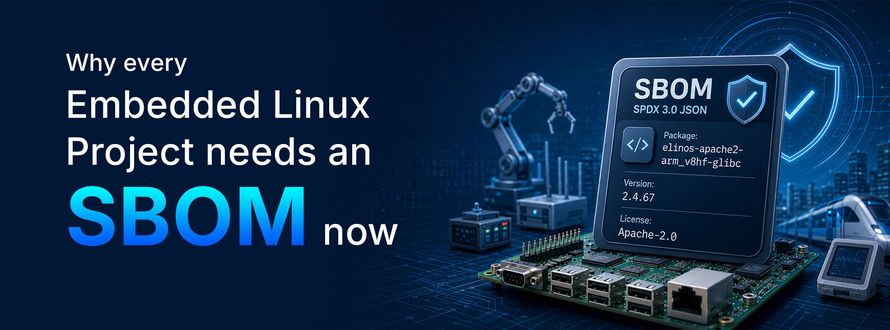
This is the approach taken in ELinOS 8. Whenever a new system project is built, ELinOS automatically generates an SBOM in SPDX 3.0 JSON format. No additional configuration is required.
The generated SBOM contains information about all software packages and files included in the final system image and is stored as part of the project build artifacts.
Because the SBOM is generated automatically during the build process, it always reflects the exact software composition of the resulting image.
Developers can use the generated SBOM for:
- Security and vulnerability analysis
- Open-source license verification
- Software inventory management
- Dependency tracking
- Customer and regulatory documentation
Looking beyond Compliance
While regulatory requirements are driving SBOM adoption, the real value lies elsewhere. An accurate SBOM helps engineering teams maintain control over increasingly complex software stacks. It improves traceability, simplifies maintenance, accelerates security analysis, and provides greater confidence when products remain in the field for ten years or more.
For embedded systems with long lifecycles, software transparency is no longer simply a compliance requirement—it has become a fundamental engineering capability. As embedded software continues to grow in complexity, the question is no longer whether your project should have an SBOM. The question is whether you can afford to operate without one.
ELinOS 8: Security and Transparency by Design
As the European Industrial Linux, ELinOS has always focused on delivering secure, maintainable, and long-lived embedded systems. With ELinOS 8, SYSGO extends this approach through integrated SBOM generation, helping development teams gain full visibility into their software supply chains while simplifying vulnerability management and compliance activities.
By combining software transparency, advanced security features, broad hardware support, and an easy-to-use development environment, ELinOS enables engineers to focus on building innovative products rather than managing infrastructure complexity. The result is a secure and future-ready Linux platform designed for the challenges of modern embedded systems.
Want to try it out? Download our free ELinOS Test Version: www.sysgo.com/get-elinos
 Twitter
 LinkedIn
 Facebook
 Reddit
 RSS
RSS Copy link