Combining Deterministic Real-Time Execution with Advanced Avionics Graphics
At the foundation of the joint solution is PikeOS, SYSGO's field-proven real-time operating system and hypervisor, developed for safety- and security-critical embedded systems. With more than two decades of deployment experience, PikeOS provides a deterministic execution environment, controlled resource management, and a mature software architecture designed to support the highest levels of safety assurance, including DO-178C Design Assurance Level A (DAL A).
PikeOS provides the underlying operating system services needed to execute time-critical avionics applications predictably and reliably. Its real-time scheduling capabilities, memory protection, and controlled execution environment offer a robust foundation for PACE's software-based rendering technology. In particular, its certification-oriented development approach and available certification evidence help manufacturers integrate the graphics subsystem into their overall avionics' certification activities.
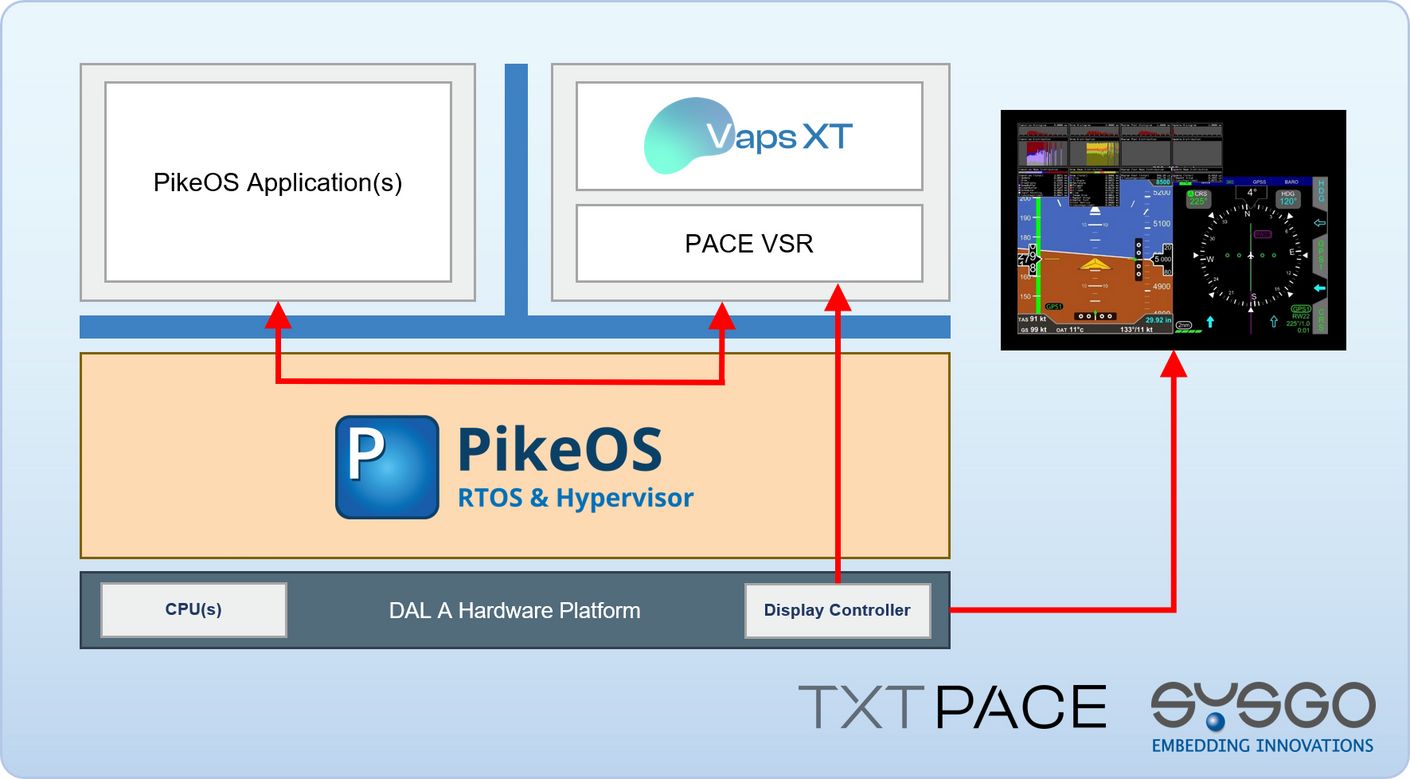
PACE contributes its advanced VAPS XT HMI development environment and VAPS Software Renderer (VSR), enabling developers to design and deploy sophisticated cockpit displays without requiring dedicated GPU hardware. Instead of depending on complex hardware-accelerated graphics drivers, VSR performs graphics rendering in software on the CPU. The approach provides predictable graphics processing, increases hardware flexibility, and can reduce the complexity associated with certifying safety-critical display applications.
Together, these technologies establish a software architecture in which graphics design, rendering, and real-time execution are supported by complementary technologies engineered with avionics certification requirements at their core.
Simplifying Certification and Reducing Hardware Dependencies
One of the key advantages of the collaboration is its potential to reduce the effort and risk associated with deploying certifiable avionics graphics.
Traditional graphics subsystems frequently depend on specialized GPUs, proprietary drivers, and complex hardware interfaces. These components can introduce additional verification requirements and limit the selection of computing platforms, particularly where high levels of safety assurance are required.
By enabling CPU-based rendering, PACE's VSR can eliminate the need for a dedicated GPU in high-DAL 2D avionics display applications. Combined with PikeOS, this creates opportunities to reduce hardware dependencies, simplify software integration, and lower system cost while maintaining deterministic real-time behavior.
Both technologies are designed to support certification activities up to DO-178C DAL A. SYSGO provides comprehensive certification kits and engineering expertise, while PACE brings more than 40 years of VAPS experience, its own certification kits and tools, and a graphics rendering architecture specifically developed to address the verification and certification challenges of avionics displays. Their complementary approaches can help OEMs establish a more predictable, lower-risk path from application development to system-level certification.
"Safety-critical avionics applications demand more than high-performance software. They require predictable execution, long-term reliability, and a development foundation that supports certification from the very beginning," says Carsten Beck, Product Strategist at SYSGO. "Together with PACE, we are bringing our experience in certifiable real-time operating systems into the world of cockpit graphics. By combining PikeOS with software-based rendering, we can help aerospace manufacturers reduce integration complexity and hardware dependencies while maintaining the high assurance levels required in modern avionics."
Greater Flexibility for Next-Generation Avionics Platforms
Beyond certification, the collaboration addresses the growing demand for adaptable and hardware-independent avionics software.
PACE's VAPS XT HMI and embedded graphics development tool enables engineers to create advanced graphical interfaces from early-stage prototyping through to certification, while VSR provides portable software rendering technology for embedded platforms. With PikeOS serving as the real-time operating system, the resulting architecture offers flexibility for deploying cockpit displays and other safety-critical visualization applications across a broad range of airborne systems.
Where required, PikeOS can additionally support partitioned and mixed-criticality architectures, enabling applications with different safety requirements to coexist on a shared computing platform under controlled execution conditions. This provides system architects with opportunities for future functional consolidation without making a complex hypervisor configuration a prerequisite for implementing the graphics solution.
"The VAPS Software Renderer addresses one of the aviation industry's most persistent challenges: Delivering certifiable, high-DAL cockpit graphics while reducing both hardware requirements and certification complexity," says Andrea Bassi, Head of HMI & Embedded Graphics at PACE. "SYSGO's PikeOS provides an excellent foundation for this approach, bringing proven real-time capabilities and extensive certification expertise. Together, we offer avionics developers greater freedom in their hardware choices and a more streamlined approach to building safety-critical displays."
Strengthening European Technological Sovereignty
As European aerospace manufacturers increasingly focus on technological independence, secure supply chains, and long-term control over critical technologies, the partnership also reinforces the strategic value of embedded software from European suppliers.
Both SYSGO and PACE are European companies, contributing decades of specialized aerospace experience, established engineering capabilities, and proven certifiable technologies. Their collaboration offers manufacturers an alternative to graphics architectures dependent on proprietary GPU technologies and complex third-party software stacks.
By combining certifiable real-time execution with advanced software rendering, the companies aim to support a new generation of avionics platforms that are reliable, adaptable, and easier to maintain throughout their operational lifecycles.
The collaboration reflects a shared commitment to making safety-critical avionics technology more accessible, reducing unnecessary system complexity, and supporting the continued development of sovereign European aerospace capabilities.
About PACE
PACE, a subsidiary of TXT e-solutions, is an international, specialized provider of engineering software solutions that support customers in high-tech markets throughout their mission- and business-critical processes and their product lifecycles. PACE develops innovative, highly usable software products that have helped to design, market and operate a significant portion of the world’s aircraft for more than three decades. Its VAPS product family supports the development of safety- and mission-critical human-machine interfaces and embedded display applications. PACE’s extensive customer base includes the world’s top aircraft and engine manufacturers, civil and military operators, maintenance service providers and research institutions.
Press contact: lucas.florian@pace.de
More information at www.pace.de and at vaps.txtgroup.com


 Twitter
 LinkedIn
 Facebook
 Reddit
 RSS
 Copy link


