
PikeOS
The safe and secure RTOS & Hypervisor
for Mission-critical embedded Systems
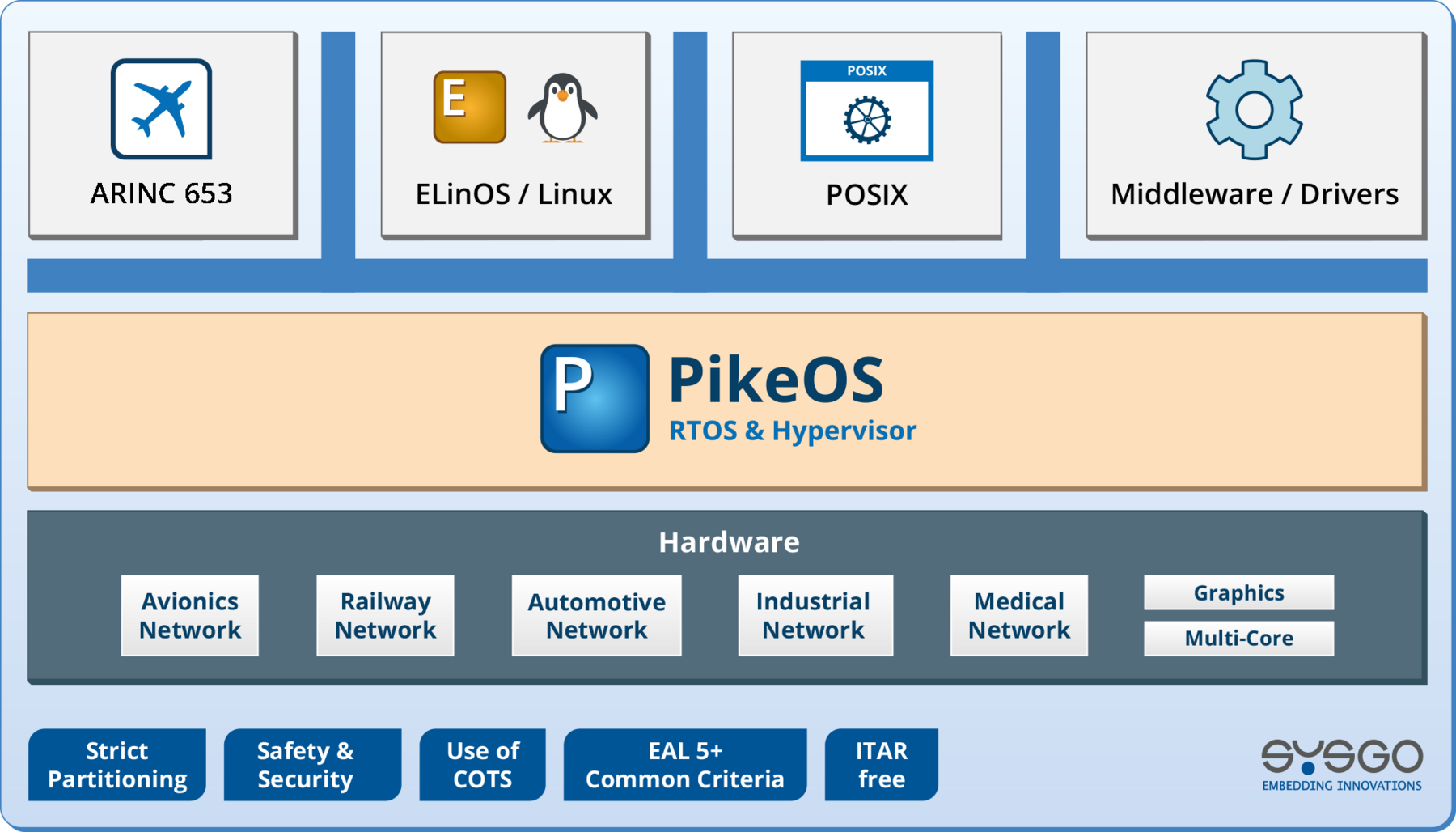
- Separation kernel-based hypervisor
- Multiple and strictly separated partitions
- Guest operating systems and applications
- Compliant to the highest Safety & Security standards
- Avionics & Space, Railway, Automotive, Industrial Automation and Medical

Real-Time Performance
PikeOS ensures predictable and reliable real-time performance, making it ideal for critical applications
Application Separation
PikeOS offers strict partitioning and strong separation to provide built-in Security by design
Hardware Consolidation
Extreme flexibility provides independence from suppliers in the choice of hardware architectures
Use of COTS
The benefit of using Commercial-Off-The-Shelf (COTS) components is to lower overall costs for applications
Certification Kits
SYSGO offers the right Safety & Security certification kits to help facing certification authorities
ITAR-free
As European company, our products have no export restrictions enabling unrestricted global deployment



The Gold Standard of Isolation
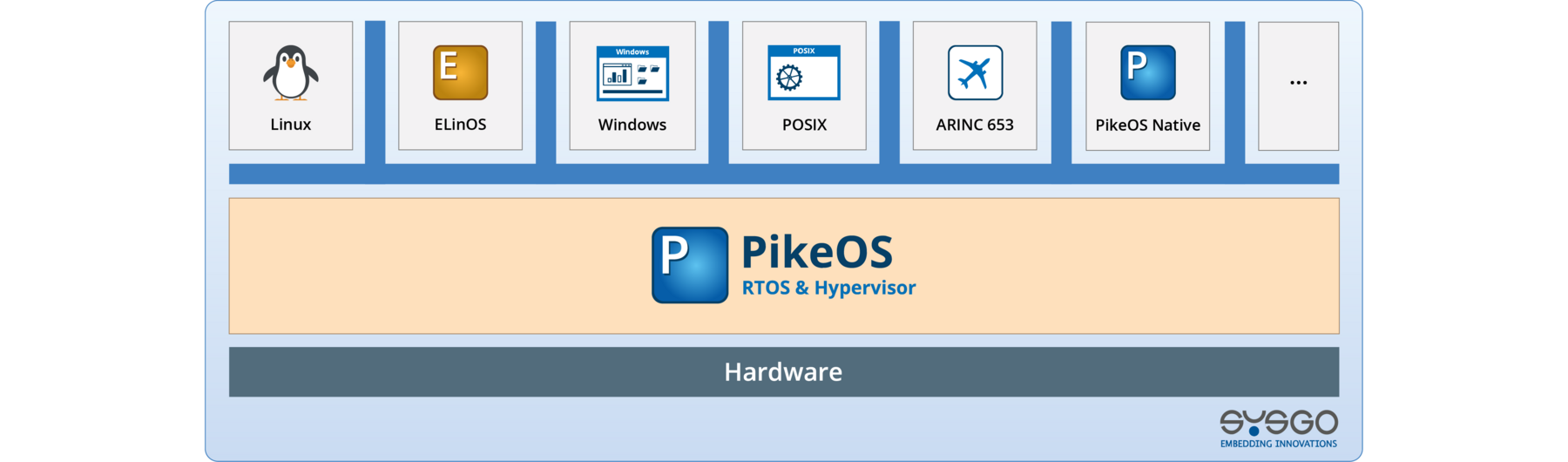
PikeOS is a separation kernel-based Type 1 Hypervisor. It runs directly on your hardware, creating hardware-enforced partitions that strictly isolate applications from one another. This ensures that a failure in a non-critical partition (like a Linux-based HMI) can never compromise a Safety-critical control loop (like an ASIL D braking system).
Mixed-Criticality Consolidation
In the era of Software-Defined Vehicles (SDV) and Integrated Modular Avionics (IMA), hardware complexity is the enemy. PikeOS allows you to consolidate multiple legacy systems and modern applications—running ELinOS, Android, POSIX, and AUTOSAR—onto a single, high-performance SoC. This radically reduces space, weight, power, and cost while simplifying your wiring and thermal management.
Certification-ready by Design
Don't start your certification process from zero. PikeOS is engineered for the highest integrity levels: SIL 4, DAL A, and ASIL D. With our pre-qualified Certification Kits, we provide the documentation and artifacts you need to satisfy auditors for DO-178C, EN 50128, ISO 26262, or Common Criteria. It is the only platform that offers a "Safe & Secure by Design" foundation for the global market.
Accelerated Development & Simulation
Complexity shouldn't mean slow development. Our CODEO IDE provides a unified, graphical environment for system configuration, analysis, and debugging. Combined with our integrated QEMU-based simulation, your software team can begin developing and testing partitioning schemes on their Linux or Windows hosts before the first piece of custom hardware even arrives.

Safety & Security
Certification

Certification Kits
(Documentation & Artifacts)
Common Criteria EAL 5+
Security Certification
Deterministic Real-Time Separation Kernel

Strict Time & Space Partitioning
(Robust Isolation)
Multiple Independent Levels
of Security (MILS)

Secure Boot &
Hardware Root of Trust
Trusted Platform Module (TPM)
Hardware Security Module (HSM)

Health Monitoring &
Error Management Framework
Preemptive Real-Time Scheduling

Type 1 Hypervisor

Hardware Virtualization
Multi-Core Support
(SMP & AMP Multiprocessing)

Multiple Guest OS
(Linux, POSIX, Windows, …)

Cache Coloring
Fine-Grained Locking

Inter-Core Communication
Intrusion Detection & Integrated
Firewalls for Guest Partitions
wolfSSL & CycurHSM:
Integrated Security & Crypto Libraries

Certified Network Stacks
(TCP/IP, UDP, AFDX, ARINC 664)
Certified IP Networking (CIP)

Certifiable File System (CFS)

Certifiable Math Library (CML)

Device Driver Framework

Property-Based Runtime Configuration
Native Graphics & Virtualized
GUI Support (GPU Sharing)
System-wide Debugging &
Hardware Trace Support
Multi-Language Support
(C/C++, Ada, Rust)
QEMU-based HW Emulators &
Target Simulators
CODEO: Eclipse-based Integrated Development Environment

ELinOS Embedded Linux
Our ELinOS distribution provides seamless integration with PikeOS virtual machines and direct use of enhanced PikeOS features. Linux partitions are frequently combined with POSIX or ARINC 653 partitions in mixed-criticality systems. PikeOS ensures that Linux has no impact on the certification of higher-criticality APIs and supports both hardware and para-virtualized execution.
Windows
Supporting Intel hardware virtualization, PikeOS can seamlessly run an unmodified and fully functional Windows together with other guest operating systems on one single platform. For older systems, our solution can safeguard legacy assets while enabling interaction with more modern, secure Windows environments for communication purposes.
POSIX
The POSIX API (Portable Operating System Interface) implements a subset of the PSE52 real-time controller system profile. It is a good choice for medium Safety-critical systems where a huge number of operating system services are required, but the use of Linux would still be too risky. It is often used for Automotive projects where ISO 26262 compliance is necessary. The POSIX API is the backbone of the AUTOSAR adaptive solution.

ARINC 653 (aka APEX)
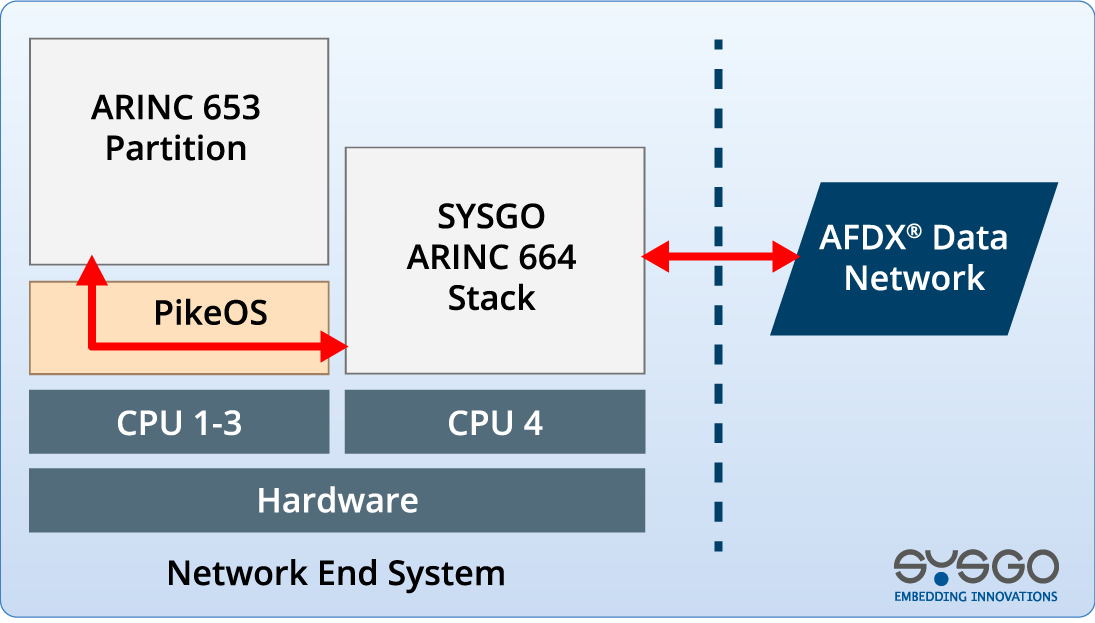
The PikeOS ARINC 653 is built upon the PikeOS native API and provides a complete and fully functional APEX API target for Avionics systems, in particular with respect to Integrated Modular Avionics (IMA). The ARINC 653 guest operating system can be certified according to DO-178C DAL A.

PikeOS Native
The PikeOS native API is primarily designed to build para-virtualized guest operating systems. It provides a small but complete set of low-level system calls that are optimized for performance, robustness, Safety and Security. The PikeOS native API is also the first choice when it comes to software to be certified at the highest certification levels.

Your specific Project
We support you in the implementation and execution of a wide range of hosted operating systems, runtime environments, and APIs on top of PikeOS. Our approach is designed to ensure optimal integration, performance, and reliability, while meeting stringent requirements for Safety, Security, and certification across diverse project needs.

Certifiable IP Stack (CIP)
CIP is a UDP/IP networking stack compatible with the standard RFC specifications. It is available for the POSIX and PikeOS APIs and provides a standard socket interface. CIP is certifiable within the scope of Safety projects.

Certifiable File System (CFS)
The CFS is a PikeOS component that provides a fail-safe file system with more functionality than the PikeOS native file system. In addition to the basic file operations implemented by the internal PikeOS file providers, the CFS can also handle directories and file manipulations. It is still a simplified file system compared to standard Linux file systems and is certifiable within the scope of Safety projects.

Certifiable Math Library (CML)
The CML provides various mathematical functions of the C standard library. CML is certifiable within the scope of Safety projects.
Rust Programming Language
By incorporating Embedded Rust into PikeOS, SYSGO is able to offer its customers a highly secure and reliable solution for their embedded systems.
MATLAB® Simulink®
MATLAB’s powerful modeling software Simulink by MathWorks enables the rapid development of technical, physical, and financial models in various engineering domains and is integrated with PikeOS as an extension.

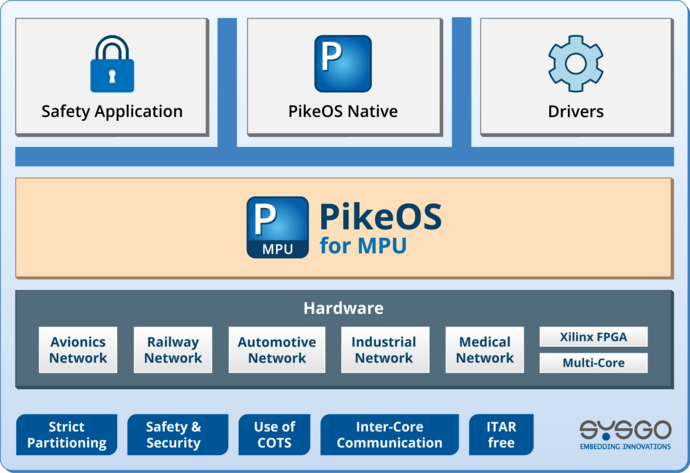
PikeOS for MPU
Real-Time Partitioning for MPU Architectures
PikeOS for MPU is aiming to provide a safe and secure execution environment for medium-sized hardware platforms which do not provide a memory management unit (MMU) and therefore cannot run the standard PikeOS.
PikeOS for MPU is intended to be used on MPU-based SoCs as well as on heterogeneous SoC implementing MMU and MPU clusters.
Ready for Security: PikeOS for MPU is ready as secure Space RTOS.

Professional Support
We provide two types of product support: The Standard Support covers the basic questions on the product use (installation, tools usage etc.) via E-Mail. The Premium Support offers more customer-specific help with direct contact to a dedicated support engineer.

Life Cycle Updates
Customers can benefit from ongoing improvements by accessing the SYSGO customer portal, where the latest updates of target binaries, new Board Support Packages, and add-ons are available.

Training & Consulting
We want to make building your target devices as convenient as possible. However, SYSGO’s guided trainings boost the skills of your embedded developer team and maximizes the output – for efficient teams that love to develop for embedded devices.